Poly Headsets: The Definitive Guide to Professional Audio Excellence

 Business Tech Review
 In the modern symphony of life, silence has become the most expensive commodity. Between the clatter of open-plan offices, the digital ping of endless notifications, and the chaotic soundtrack of remote work life—barking dogs, doorbells, and the hum of urban existence—the ability to hear and be heard clearly is no longer a convenience; it is a radical act of professional preservation. Within this acoustic battleground, Poly headsets have emerged not merely as audio devices, but as architects of the cognitive environment. They represent a meticulous marriage of hardware engineering and acoustic science, designed to carve out bubbles of pristine intelligibility in a world drowning in noise.
We live in an era defined by the hybrid mandate. The physical boardroom and the digital Zoom window have fused into a single, demanding entity. In this space, the weight of a device on your head, the pressure of an ear cushion, and the precision of a noise-canceling microphone are not minor ergonomic footnotes; they are the defining factors between a productive conversation and a frustrating exercise in repetition. To wear a Poly headset is to understand that communication technology is deeply personal. It touches the skin, sits millimeters from the eardrum, and carries the vibration of the human voice. This exploration delves into the philosophy, utility, and engineering mastery behind devices that have become the unsung heroes of the global workforce, specifically focusing on how Poly headsets transform the sensory experience of labor.
The Anatomy of Acoustic Clarity
To appreciate why Poly headsets are distinct in a saturated market, one must first understand that sound is brutal. It is physics without mercy. Sound waves reflect off glass desks, get absorbed by cheap ceiling tiles, and scatter in unpredictable patterns. Capturing the human voice—a complex instrument ranging from 85 Hz to 255 Hz for fundamental spoken frequencies, yet rich with harmonics up to 8,000 Hz for consonant intelligibility—requires a brutalist approach to engineering. This is where the legendary legacy of Plantronics and Polycom, the twin pillars now unified under the Poly brand, becomes tangible.
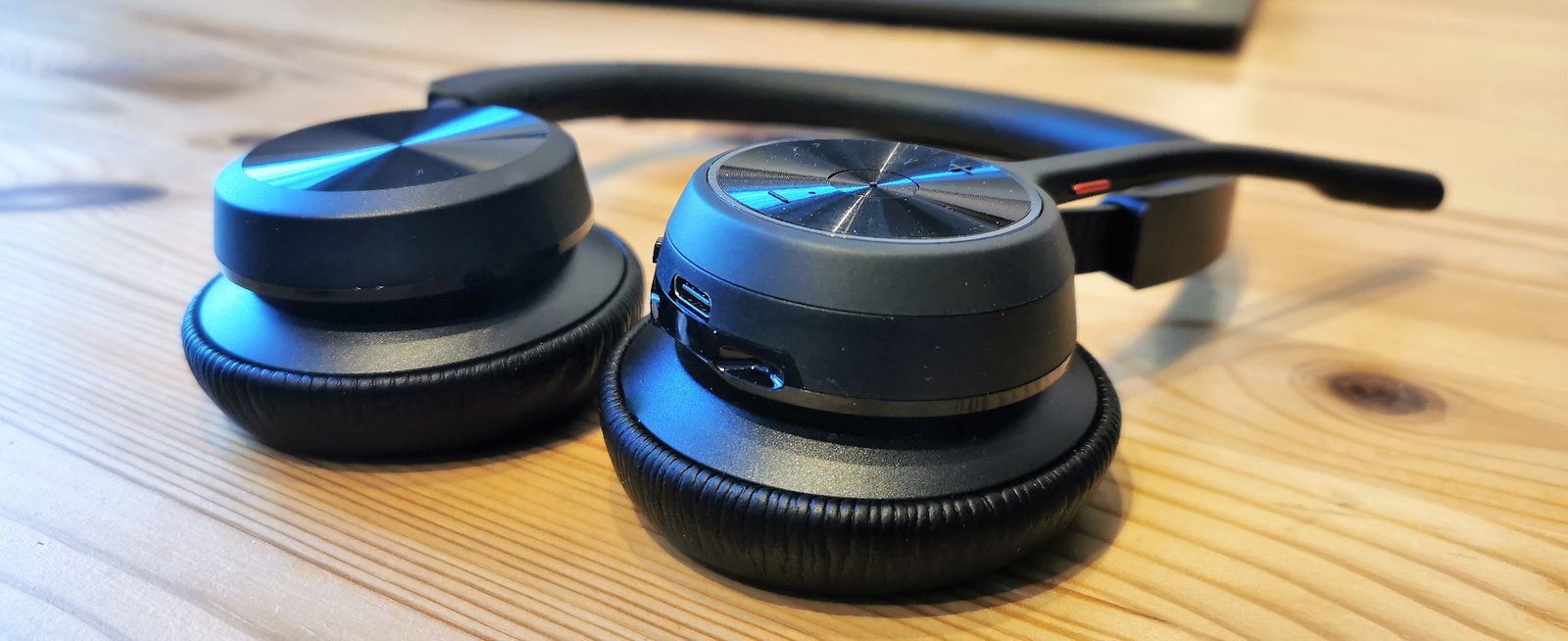
The microphone boom is not just a stick of plastic. In professional-grade Poly headsets, the boom is a tuned acoustic chamber. If you look closely at models in the Voyager or Blackwire series, you notice a precise physical architecture: the distance from the corner of the mouth is calculated, not guessed. Placing the microphone capsule exactly two finger-widths from the chin creates a pressure zone where voice energy is maximized and ambient energy is mechanically phased out before it ever touches the digital signal processor. This is what Poly engineers call the “noise firewall.” It is a physical barrier against chaos.
But the magic, if one can use that word in engineering, lies in the multi-microphone array. A typical Poly headsets design for a call center or executive office does not listen with just one ear. It listens with multiple. One microphone focuses on the voice. Another, often facing outward, listens exclusively to the background. The onboard chipset then performs a real-time subtraction algorithm. It is a mathematical race. The sound of a colleague’s mechanical keyboard, the hum of an HVAC system, or the dreaded coffee grinder is sampled, inverted, and canceled in microseconds. This is not the brute-force noise suppression of the past that made voices sound like underwater robots. This is surgical filtration, preserving the lower frequencies of the chest voice—the warmth and authority—while excising the mechanical whine of a desk fan.
The Ergonomics of the Forgotten Senses
We often speak of headsets in terms of decibels and frequency response curves, but we rarely speak of the flesh. The human ear is a masterpiece of evolution, but it was not designed to be clamped for ten hours a day. The helix, the antihelix, the tragus—these delicate cartilages suffer under the tyranny of bad design. The philosophy behind Poly headsets acknowledges a simple truth: if a device hurts, it will be removed. If it is removed, communication stops.
Therefore, we enter the realm of material science. The leatherette used in high-tier Poly ear cushions is not just a cover; it is a phase-change material analog. It must not trap heat. The internal memory foam must possess a specific indentation force deflection (IFD). Too stiff, and it bruises the mastoid bone. Too soft, and the driver collapses against the ear, muffling the sound. Poly’s engineering here is invisible. Look at a well-worn set of Savi or Blackwire cushions. They don’t flake. They don’t bottom out. They maintain a constant, passive spring force that distributes the 200-gram weight of the headset across the maximum surface area of the temporal bone. This is called “T-Pad” loading in ergonomic circles. It shifts pressure away from the delicate cartilage ridges and onto the harder, flatter skull plate, a design nuance that allows a user to finish a three-hour strategic review without the headache that lesser hardware inflicts.
Furthermore, the headband tension is a study in dynamic loading. A band that is too tight causes contact dermatitis and “hot spots” on the crown of the head. A band that is too loose shifts the gravitational burden entirely to the ear cups, causing a pinching pain known as “scaphoid fossa compression.” The stainless steel sliders in the Voyager series are calibrated to a clamp force that seems paradoxical—secure enough for a jog, yet loose enough to forget you are wearing them. This is the art of biometric engineering, and it is the reason why Poly headsets often outlive the laptops they are paired with.
The Software-Defined Boundary
We cannot discuss Poly headsets without acknowledging the silicon brain that lives within them, a subject deeply tied to the “blood” of the device: its firmware. The software that breathes life into the hardware is as critical as the diaphragm of the speaker. The evolution of Poly Lens, the cloud-based desktop and mobile application, transforms a passive piece of acoustic foam into an intelligent sentinel.
Imagine an open-plan office. The noise profile at 9:00 AM is different from the noise profile at 4:00 PM. Morning is filled with greetings and coffee rituals; the afternoon is a dense fog of simultaneous conversations. In the past, a noise-canceling algorithm was static. It was a frozen instruction set. But with modern Poly technology, the headset is contextually aware. Adaptive ANC (Active Noise Cancellation) reacts to the pressure wave environment in real time. However, the true evolution is in the “Acoustic Fence” technology found in the Voyager Focus 2 and similar models.
Think of Acoustic Fence not as noise canceling, but as digital xenophobia for sound. You define a bubble. Only sounds originating inside that radius—your mouth—are allowed to pass through. A person standing three feet away, laughing loudly, is acoustically erased. The DSP chipset is analyzing voice print characteristics against spatial vector data. It knows your voice because it expects the proximity. This is a game of inches, and in the race against distraction, those inches are miles. This feature, fine-tuned through Poly Lens, is a testament to why the “blood” of the system—the deep, adaptive code—is the life force that keeps the hardware relevant years after purchase.
Designing for the Hybrid Nomad
The shift from the cubicle farm to the living room has not simplified audio; it has complicated it to a terrifying degree. The office was a controlled hell—predictable in its drone of printers and chatter. The home is an unpredictable hell—a sudden doorbell, a glass smashing in the kitchen, a low-flying airplane rattling the windows. For the hybrid professional, the headset must transition from a communication tool to a focus sanctuary.
This is where the dual-mode capability of Poly headsets shines. The ability to seamlessly switch from a softphone ring on a computer to a cellular call on a mobile device is not just a convenience; it is a bridge between the fragmented halves of a professional life. A user might be listening to a meditation track on their phone to calm their nerves between meetings, only to instantly punch into a high-stakes client call on Teams with the press of a button. The Bluetooth profiles on these devices are complex. They must negotiate with Windows, macOS, iOS, and Android, all of which handle audio codecs differently.
The boom arm becomes a visual flag in this environment. When the boom is up, the world sees you as unavailable. When it drops, the magnetic reed switch triggers an instant answer. This physicality is essential. In the digital world, we click icons. But physical fatigue manifests as a hatred for clicking. The physical act of lowering a microphone boom is a conscious gesture of entering “work mode.” It is the psychological boundary that separates the domestic self from the professional operator. The heavy, satisfying detent of a Poly boom arm rotation is engineered to signal permanence. It doesn’t flop; it locks, telling your brain, “This is where you sit, and this is where you stay until the job is done.”
The Hidden Economics of Obsolescence
Value in professional audio is not defined by the purchase price but by the cost per hour of use. This is a metric that separates toys from tools. The “blood” of an organization’s communication budget is often hemorrhaged by buying cheap, disposable headsets that break within a fiscal quarter. The physical integrity of Poly headsets introduces a different economic calculus: Total Cost of Ownership (TCO) balanced against Mean Time Between Failures (MTBF).
A broken headset is an IT ticket. An IT ticket costs money. A user sitting idle while a replacement arrives costs even more. Therefore, the use of glass-fiber reinforced polymer in the swivel joints of the Blackwire series is not an aesthetic choice; it is an economic guarantee. The Kevlar-reinforced cables—found in specific corded models designed for high-density contact centers—are engineered to survive a rolling chair castor. If you have ever run over a headset cable with a chair, you know the sound of structural death. Poly engineers studied that specific stress fracture point and embedded a tensile matrix that resists that exact lateral crush force.
This durability extends to the battery chemistry. Lithium-ion cells are the “blood” of a wireless headset. They are volatile, living organisms that degrade with every charge cycle. Poly’s power management strategy is famously conservative, prioritizing longevity over reckless, fast-drain charging. A battery that easily lasts two years before hitting 80% capacity is a battery that delays the headset’s journey to the landfill. This sustainable approach, looking at hardware as a long-term service vehicle rather than a disposable wrapper, defines the ethical backbone of the Poly ecosystem.
Immersive Soundscapes and the Wellness Connection
The conversation around professional headsets often ignores the user’s cortisol levels. High-pitched background noise, uneven frequency responses, and squawky side tones create a physiological stress response known as auditory defensiveness. The brain tenses up. Concentration shatters. A well-tuned headset, however, can induce an almost meditative state.
The bass reflex ports in the listening drivers of Poly headsets are not just for playing music; they are for recreating the natural resonance of the human chest cavity. When we talk to someone in person, we feel subsonic vibrations through the air. A “thin” phone call—traditionally the 300 Hz to 3.4 kHz narrowband of the PSTN—removes this tactility. It makes the speaker sound disembodied. Wideband audio (HD Voice) and, increasingly, full super-wideband codecs supported by Poly hardware, restore these tactile harmonics. The listener’s tympanic membrane perceives not just the words but the emotional state of the speaker. This is nuanced communication. It reduces misunderstanding and cognitive load. When you can hear the subtle inhale before a sentence, you subconsciously know when to speak, preventing the staccato collision of “Zoom lag.”
Furthermore, the “Sidetone” control—the small echo of your own voice fed back into the ear cup—is a deeply human necessity. Without sidetone, we shout. We feel disconnected from our own voice. Poly allows for the fine-tuning of this feedback loop. Hearing your own voice with crystal clarity, as if you weren’t wearing a headset at all, grounds you. It keeps your vocal level conversational, protecting the larynx from fatigue and maintaining a calm, authoritative presence that lowers the stress of everyone on the bridge.
The Aesthetics of the Professional Tool
We inhabit a visual medium now. We see ourselves as much as we hear ourselves. The “Hollywood Squares” grid of a video call is a constant mirror. A headset is a piece of industrial jewelry. A bulky, blinking, sci-fi monstrosity undermines authority. A sleek, dark, minimalist device communicates seriousness.
The design language of Poly headsets tends toward “prosumer minimalism.” They do not look like weapons. They look like precision instruments. The matte finishes diffuse light, preventing ugly reflections on camera. The visual weight is balanced. A boombox-silver headset with glowing neon rings screams “gaming,” which is a liability in a financial audit meeting. The understated graphite, the subtle perforations on the steel headband, the hidden microphones—these are intentional choices that signal the wearer is a part of the corporate machine, not an escapee from it. This visual code allows the technology to vanish, leaving only the human face and the quality of the idea being communicated.
The “Poly Headsets” Ecosystem: A Unified Fleet
No device exists in isolation. The true power of the Poly brand is the interoperability within its fleet. An IT manager deploying Poly headsets across a firm isn’t just buying hardware; they are buying a management platform. The problem of “fragmented acoustics” is the blood clot in the arteries of unified communications.
If the CEO is on a Voyager Focus 2 and the intern is on a Blackwire 3325, the audio signature should be consistent. A client should not be able to hear the difference. Poly achieves this through a house sound curve—a specific tuning of the codec and DSP that ensures vocal consistency. The sibilance (the harshness of “S” and “T” sounds) is managed uniformly. This is critical for professional recording and transcription. In an age where AI bots transcribe meetings, a harsh headset that clips on plosives ruins the record. Poly’s closed-loop design ensures the “plosive pop filter” is integrated into the mic mesh. It uses an acoustic fabric, often hydrophobic, that breaks up the high-pressure blast of air before it hits the capsule. This isn’t a piece of foam; it’s a critical velocity breaker.
For the individual professional evaluating Poly headsets, the choice ultimately boils down to a singular, ancient need: to be understood without effort. We are tribal creatures. The voice carries identity, status, and intent. When the voice is trapped behind a bad analog-to-digital converter, the speaker feels powerless. When the voice is transmitted with its full spectral richness, the speaker feels dominant. This psychological effect, known as “vocal presence,” cannot be overstated. It changes salary negotiations, sales pitches, and tough feedback conversations. It closes deals.
The act of donning a high-fidelity Poly headset in a chaotic environment is a declaration of independence. It says to the world, “I control my sensory inputs.” It is the equivalent of shutting a heavy, soundproof glass door in a noisy café. That sense of control reduces anxiety and fosters the “flow state” necessary for complex knowledge work. Whether it’s the feather-light stereo telephony of the Voyager series or the rugged, tank-like isolation of the Blackwire C-series, the goal remains identical: to make the interface between the electrical grid and the human auditory cortex invisible. The ultimate victory for Poly headsets is not when the user thinks, “What great sound,” but rather, when the user forgets they are wearing a headset at all. That is the sound of perfect engineering.
Acoustic Safety and the Protection of the Nerve
We are stewards of our hearing, yet most professionals treat their eardrums with reckless abandon. Acoustic shock—a sudden burst of high-frequency noise, a fax machine screech, or a digital feedback loop on a VoIP call—can cause lasting neurological damage. The inner ear’s cochlea is lined with hair cells that do not regenerate. Once they are flattened by a 120-decibel burst, they are gone forever, leaving a permanent high-frequency ring known as tinnitus.
This is the dark side of audio engineering that Poly headsets address through a suite of technologies known as “SoundGuard.” This is not marketing fluff; it is a guardian angel within the circuitry. The DSP analyzes incoming audio signals in real time. It distinguishes between a sudden spike in amplitude (a dropped receiver or a scream) and a legitimate loud passage of speech. Using a form of digital compression far more advanced than a simple limiter, SoundGuard caps the energy transmitted to the speaker driver. It suppresses the acoustic event within a cycle to ensure it never exceeds a safe decibel threshold. This is the equivalent of an airbag for the eardrum. It allows the user to keep the volume high enough to hear a whispering caller while guaranteeing that the next second’s unexpected electrical crackle doesn’t cause a physical flinch and a visit to the audiologist. In the brutal economics of health, this single feature is worth the price of the hardware.
The Ritual of the Connection
Finally, we must discuss the “bleeding edge” of connection stability. A wireless headset is useless if it sounds like an old transistor radio. The “blood” of a wireless Poly headsets configuration is the DECT standard or the proprietary Bluetooth implementation.
In the 2.4 GHz spectrum, the air is crowded. Wi-Fi routers, microwave ovens, and smart home hubs are screaming into the void. Poly’s adaptive frequency hopping is a survival tactic. The headset scans the spectrum hundreds of times per second, jumping to clean channels before interference even registers to the human ear. But the true luxury lies in the range. A DECT-based model allows a user to walk to the office kitchen fifty meters away and remain in a conversation without the metallic, digital crunch of a dying signal. This freedom to pace, to think kinetically, is a cognitive enhancer. The body is not designed to sit frozen in front of a ring light for eight hours. The ability to stand, stretch, and walk to the window while a superior continues to speak without interruption maintains the flow of the dialogue. The unwavering security of that connection, the encrypted stream ensuring that corporate secrets do not scatter through the radio ether, completes the triad of the perfect professional audio device: clarity, safety, and absolute freedom of movement. Through this relentless dedication to the physiology of the user and the physics of the environment, the world of Poly headsets continues to define what it truly means to connect in a fractured world.