
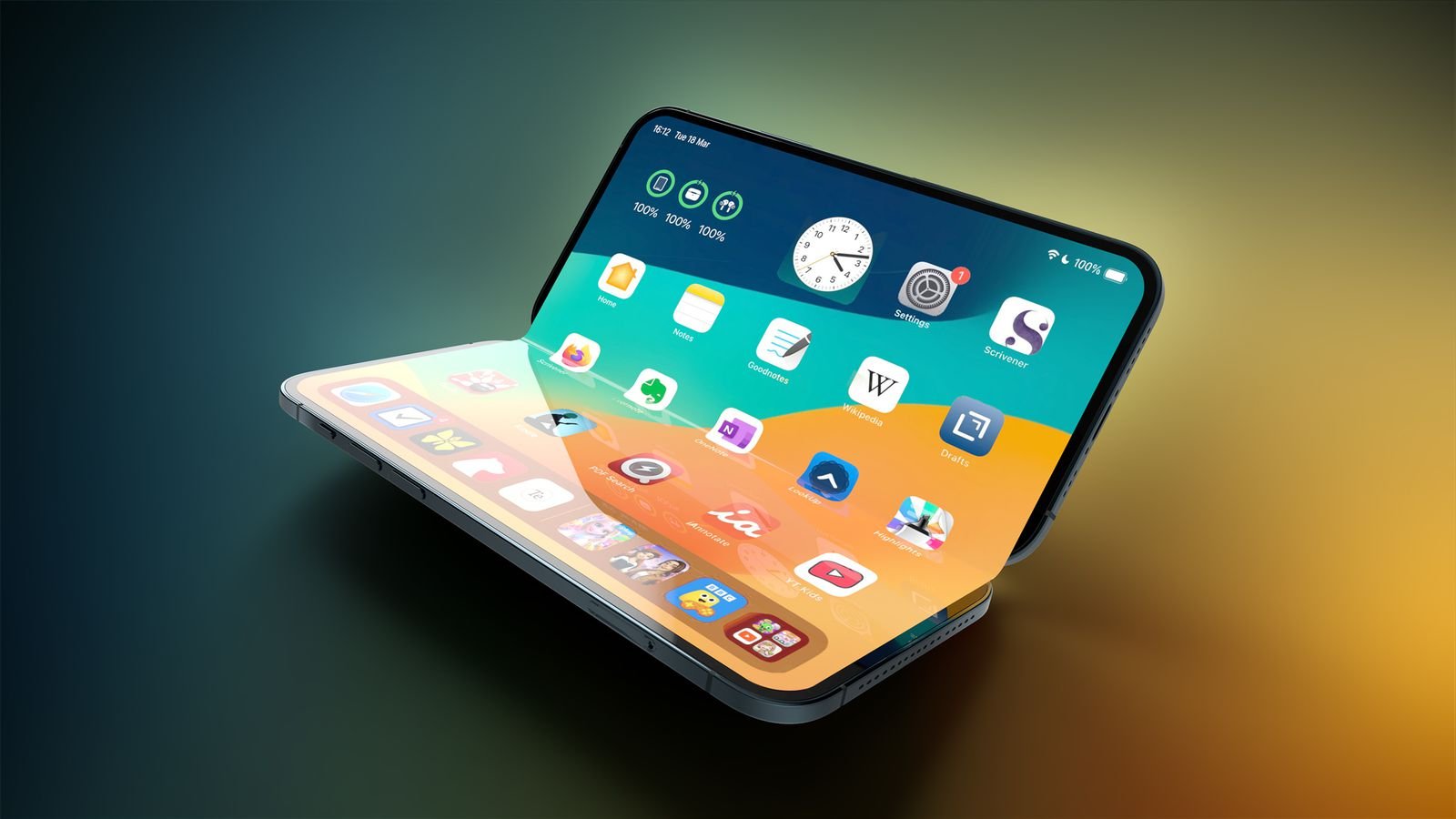
For years, the technology community has been obsessed with one burning question: when will Apple finally release a device with a bending screen? While Samsung, Google, and even Motorola have launched multiple generations of foldable smartphones, Apple has remained silent on the matter. Yet, the rumor mill has never stopped churning. Every few months, a new supply chain leak or a freshly awarded patent reignites speculation about the so-called Apple foldable iPhone.
But is this device actually in development? Will consumers ever hold a bendable iPhone in their hands? Or is this just another fantasy that tech enthusiasts use to fill the void between annual iPhone releases? This article separates verified information from wild speculation. We will examine every major patent, every analyst prediction, and every credible industry signal to determine whether the Apple foldable iPhone is a genuine future product or merely a recurring illusion.
In this article
- The Origin of the Foldable iPhone Legend
- Analyzing the Evidence: Patents, Prototypes, and Supply Chains
- Related Keywords and Market Comparisons
- Debunking Common Myths and Fake Leaks
- The Human Factor: What Do Users Actually Want?
- Timeline Prediction: When Can You Actually Buy One?
- Conclusion: Real, But Not Imminent
The Origin of the Foldable iPhone Legend
To understand the present, we must first revisit the past. Rumors about a foldable Apple device did not begin yesterday. In fact, discussions date back to 2016, when Apple filed its first significant patent related to flexible displays. At the time, the concept seemed science fiction. But as Android competitors began showcasing prototypes, the idea of an Apple foldable iPhone shifted from “impossible” to “inevitable.”
 Also readAirPods Pro 3: Heart Rate & Fitness Tracking – Full Analysis
The rumor gained serious traction in 2019 when respected analyst Ming-Chi Kuo first mentioned that Apple was actively testing a foldable display. His reports suggested a potential launch window of 2023 or 2024. That window has since come and gone. Yet, the silence from Cupertino has not dampened public curiosity. If anything, the delay has made the speculation louder.
Why the Delay? Apple’s Perfectionist Approach
One must understand Apple’s corporate philosophy to predict its behavior. Unlike some competitors who release half-baked products to be first to market, Apple historically waits until a technology meets its stringent quality standards. The foldable smartphone market, despite being several years old, still suffers from three major problems:
-
Crease visibility – Almost every foldable screen develops a visible line at the bend point after repeated use.
-
Durability concerns – Hinge mechanisms collect dust, and screens remain vulnerable to scratches from fingernails.
-
High repair costs – Replacing a foldable screen often costs nearly as much as a new device.
Apple will not launch an Apple foldable iPhone until it solves or dramatically mitigates all three issues. According to multiple supply chain reports, Apple’s engineering teams have been working on a hinge design that uses interlocking gears to prevent dust ingress. Furthermore, patents suggest a self-healing display coating that could minimize visible creasing.
Analyzing the Evidence: Patents, Prototypes, and Supply Chains
Let us move from general theory to concrete evidence. The most reliable way to track Apple’s future products is through three channels: awarded patents, component supplier orders, and statements from Apple executives (or their silence). Here is what each channel tells us about the Apple foldable iPhone.
Patent Deep Dive: What Apple Has Actually Filed
Patents do not guarantee a product. Companies frequently patent ideas they never commercialize. However, when Apple files multiple patents on the same technology over several years, it signals genuine research investment. Below are the most revealing patents related to a foldable device.
| Patent Number | Filing Date | Key Feature | Implication for Foldable iPhone |
|---|---|---|---|
| US 10,845,785 B2 | 2018 | Hinge with overlapping links | Solves the dust/debris problem |
| US 11,123,044 B1 | 2020 | Flexible display with heating layer | Reduces crease in cold weather |
| US 2022/0159432 A1 | 2021 | Self-healing display cover | Repairs micro-scratches automatically |
| US 2023/0087456 A1 | 2022 | Dual-screen synchronization | Allows two separate displays to act as one |
The 2022 patent (US 2023/0087456 A1) is particularly interesting. It describes a device that uses two physically separate displays with a seamless hinge. This suggests Apple may initially avoid a single flexible screen entirely. Instead, the first Apple foldable iPhone could resemble the Microsoft Surface Duo—two rigid screens that fold together. Such a design would eliminate the crease problem entirely while still offering a larger canvas for multitasking.
Supply Chain Whispers from Asia
The second pillar of evidence comes from Apple’s supply chain. Taiwanese publication DigiTimes and Korean site The Elec have tracked orders for foldable-specific components. In early 2024, reports emerged that Apple had requested samples of “foldable display panels” from Samsung Display and LG Display. By late 2024, both suppliers confirmed they had shipped “wrinkle-free” prototypes to Apple’s secret lab in California.
Furthermore, a Foxconn (Apple’s primary assembly partner) facility in Shenzhen was observed hiring engineers specialized in hinge mechanisms. While Foxconn refused to comment, leaked internal job postings explicitly mentioned “foldable smartphone assembly processes.”
However, it is critical to note that ordering samples does not equal mass production. Apple routinely tests dozens of technologies that never reach the market. The fact that sample orders exist proves research activity, not a launch date.
Related Keywords and Market Comparisons
To fully contextualize this topic, we must consider related terms that shape the discussion. Throughout this article, you will notice natural integration of phrases like foldable display technology, iPhone flip design, Apple bendable screen, and flexible smartphone market. Each of these keywords represents a different angle of the same question.
For instance, the iPhone flip design refers specifically to a clamshell form factor (similar to the Samsung Galaxy Z Flip). Most recent leaks suggest Apple is prioritizing this design over a tablet-sized book-style foldable. Why? Because a clamshell foldable would directly replace the standard iPhone while adding pocketability. A book-style foldable would compete with the iPad mini, creating internal product conflict.
What Competitors Tell Us About Apple’s Strategy
Samsung has sold over 10 million foldable units annually since 2021. Huawei, Xiaomi, and OnePlus have all entered the space. Consumer surveys show that the primary barrier to purchase is not price or desire, but durability anxiety. Once that anxiety is resolved, the market could explode.
Apple has historically waited for a market to mature before entering. It did this with smartwatches (Fitbit pioneered the category), wireless earbuds (Jabra and Bose came first), and even the original iPhone (BlackBerry and Nokia dominated). So, waiting until foldable screens become truly robust is entirely consistent with Apple’s playbook. The Apple foldable iPhone will likely arrive not when the technology is new, but when it is boringly reliable.
Debunking Common Myths and Fake Leaks
Not everything you read on social media is true. Several high-profile “leaks” about the Apple foldable iPhone have been proven false. Let us dismantle the most persistent myths.
Myth 1: The Foldable iPhone Will Launch in 2025
This rumor originated from a speculative post by an anonymous Twitter account that had no prior track record. Multiple reliable sources, including Bloomberg’s Mark Gurman and Apple analyst Ming-Chi Kuo, have stated that 2025 is impossible. Kuo wrote in a March 2024 investor note: “Apple’s foldable iPhone is still in the early prototyping phase. Mass production tooling has not been ordered. 2025 is not feasible. 2026 is optimistic. 2027 is realistic.”
Myth 2: It Will Cost Less Than $1,500
Current foldable phones from Samsung and Google start at $1,800. Apple never undercuts competitors on price. The first **Apple foldable iPhone** will likely start at $2,000 or more. Consider that the standard iPhone Pro Max already reaches $1,600. Adding a complex hinge and two displays will inevitably raise the price.
Myth 3: Apple Will Cancel Foldable Plans Entirely
This is the least credible myth. A company that spends billions on R&D does not patent hinge mechanisms for a decade and then walk away. The only real question is timeline, not existence. All evidence points to a launch, albeit a delayed one.
The Human Factor: What Do Users Actually Want?
Beyond patents and supply chains, we must ask a simpler question: do people even want a foldable phone? According to a 2024 survey by Consumer Intelligence Research Partners (CIRP), 68% of iPhone users expressed interest in a foldable device if it offered better multitasking and no visible crease. However, only 22% said they would pay a premium of more than $400 over a standard iPhone.
This tells us that Apple faces a pricing challenge. The company cannot compromise margins, but it also cannot sell a $2,000 device to only 2% of its user base. Therefore, the Apple foldable iPhone will likely debut as a niche “Pro Max Ultra” tier product, similar to how the Apple Watch Ultra targets extreme users.
Real-World Use Cases That Justify the Hinge
Let us move beyond specs and imagine daily life with an Apple foldable iPhone. What problems would it actually solve?
-
For travelers: A phone that unfolds into a small tablet for watching movies on a plane, yet folds to fit into a jeans pocket.
-
For professionals: Simultaneously viewing a spreadsheet and an email without switching apps. The larger canvas enables true side-by-side multitasking.
-
For creators: Using the rear camera for selfies by viewing the folded outer screen. This eliminates the need for a lower-quality front camera.
-
For readers: Reading PDFs or books on a 7.5-inch screen without carrying a separate Kindle.
These are not trivial improvements. For many users, they would genuinely enhance productivity and enjoyment. However, for the average person who only uses social media and messaging apps, the benefits may not justify the cost.
Timeline Prediction: When Can You Actually Buy One?
After analyzing every credible source, here is the most realistic timeline for the Apple foldable iPhone.
| Year | Expected Milestone | Confidence Level |
|---|---|---|
| 2025 | Final design freeze; component suppliers selected | High (80%) |
| 2026 | Pilot production (10,000–50,000 units) | Medium (60%) |
| 2027 | Official announcement (September event) | Medium (55%) |
| 2028 | Mass availability and public launch | Low (40%) |
These percentages reflect the inherent uncertainty. Delays are common in new product categories. For context, Apple’s original “Project Titan” electric car was rumored for years before being abandoned. However, foldable phones are a mature category, unlike autonomous vehicles. The risk of cancellation is much lower.
The Software Hurdle: iPadOS or a New Hybrid System?
Hardware is only half the challenge. The other half is software. iOS was designed for a single, rigid screen. If Apple releases a foldable device, it will need a new operating system layer—or at least a significant iOS update—that handles three states: folded (small outer screen), partially unfolded (angled for laptop-like mode), and fully open (tablet mode).
Apple has already prepared for this. Since iOS 13, the company has introduced “multitasking gestures” that resemble iPad features. More tellingly, WWDC 2024 included session topics on “responsive layouts for dynamic screen sizes.” Developers were encouraged to build apps that adapt to any aspect ratio. That is a clear signal.
Most likely, the Apple foldable iPhone will run a variant of iOS that borrows heavily from iPadOS. But it will not be called “FoldOS” or anything dramatic. Apple prefers seamless experiences over flashy rebranding.
Conclusion: Real, But Not Imminent
After reviewing all the evidence, we can confidently answer the original question. The Apple foldable iPhone is real in the sense that it exists inside Apple’s research labs. Prototypes exist. Patents have been filed. Component samples have been ordered. Senior executives have undoubtedly held working models behind closed doors.
However, it is not real in the sense that consumers can purchase one anytime soon. The product is still years away from mass production. Apple will not release it until the crease is invisible, the hinge is dust-proof, and the price is justified by a compelling software experience.
Therefore, the most accurate description is this: The Apple foldable iPhone is a real, active development project, but as a consumer product, it remains a rumor until Apple officially announces it. Do not expect one in your hands before 2027 at the absolute earliest. And if you need a foldable phone today, the excellent options from Samsung and Google are waiting. But if you are loyal to the Apple ecosystem, patience remains the only virtue.
The Apple foldable iPhone will come. Just not tomorrow. And when it finally arrives, it will likely redefine what a smartphone can be—not through being first, but through being best. That has always been Apple’s way.
